 Add to Chrome
 Add to Firefox
 Add to Edge
Beyond the final layer: Attentive multilayer fusion for vision transformers
Jan 14, 2026
With the rise of large-scale foundation models, efficiently adapting them to downstream tasks remains a central challenge. Linear probing, which freezes the backbone and trains a lightweight head, is computationally efficient but often restricted to last-layer representations. We show that task-relevant information is distributed across the network hierarchy rather than solely encoded in any of the last layers. To leverage this distribution of information, we apply an attentive probing mechanism that dynamically fuses representations from all layers of a Vision Transformer. This mechanism learns to identify the most relevant layers for a target task and combines low-level structural cues with high-level semantic abstractions. Across 20 diverse datasets and multiple pretrained foundation models, our method achieves consistent, substantial gains over standard linear probes. Attention heatmaps further reveal that tasks different from the pre-training domain benefit most from intermediate representations. Overall, our findings underscore the value of intermediate layer information and demonstrate a principled, task aware approach for unlocking their potential in probing-based adaptation.

Uncovering the Structure of Explanation Quality with Spectral Analysis
Apr 11, 2025As machine learning models are increasingly considered for high-stakes domains, effective explanation methods are crucial to ensure that their prediction strategies are transparent to the user. Over the years, numerous metrics have been proposed to assess quality of explanations. However, their practical applicability remains unclear, in particular due to a limited understanding of which specific aspects each metric rewards. In this paper we propose a new framework based on spectral analysis of explanation outcomes to systematically capture the multifaceted properties of different explanation techniques. Our analysis uncovers two distinct factors of explanation quality-stability and target sensitivity-that can be directly observed through spectral decomposition. Experiments on both MNIST and ImageNet show that popular evaluation techniques (e.g., pixel-flipping, entropy) partially capture the trade-offs between these factors. Overall, our framework provides a foundational basis for understanding explanation quality, guiding the development of more reliable techniques for evaluating explanations.
Multilevel Generative Samplers for Investigating Critical Phenomena
Mar 13, 2025Investigating critical phenomena or phase transitions is of high interest in physics and chemistry, for which Monte Carlo (MC) simulations, a crucial tool for numerically analyzing macroscopic properties of given systems, are often hindered by an emerging divergence of correlation length -- known as scale invariance at criticality (SIC) in the renormalization group theory. SIC causes the system to behave the same at any length scale, from which many existing sampling methods suffer: long-range correlations cause critical slowing down in Markov chain Monte Carlo (MCMC), and require intractably large receptive fields for generative samplers. In this paper, we propose a Renormalization-informed Generative Critical Sampler (RiGCS) -- a novel sampler specialized for near-critical systems, where SIC is leveraged as an advantage rather than a nuisance. Specifically, RiGCS builds on MultiLevel Monte Carlo (MLMC) with Heat Bath (HB) algorithms, which perform ancestral sampling from low-resolution to high-resolution lattice configurations with site-wise-independent conditional HB sampling. Although MLMC-HB is highly efficient under exact SIC, it suffers from a low acceptance rate under slight SIC violation. Notably, SIC violation always occurs in finite-size systems, and may induce long-range and higher-order interactions in the renormalized distributions, which are not considered by independent HB samplers. RiGCS enhances MLMC-HB by replacing a part of the conditional HB sampler with generative models that capture those residual interactions and improve the sampling efficiency. Our experiments show that the effective sample size of RiGCS is a few orders of magnitude higher than state-of-the-art generative model baselines in sampling configurations for 128x128 two-dimensional Ising systems.
Enhancing Diffusion Models Efficiency by Disentangling Total-Variance and Signal-to-Noise Ratio
Feb 12, 2025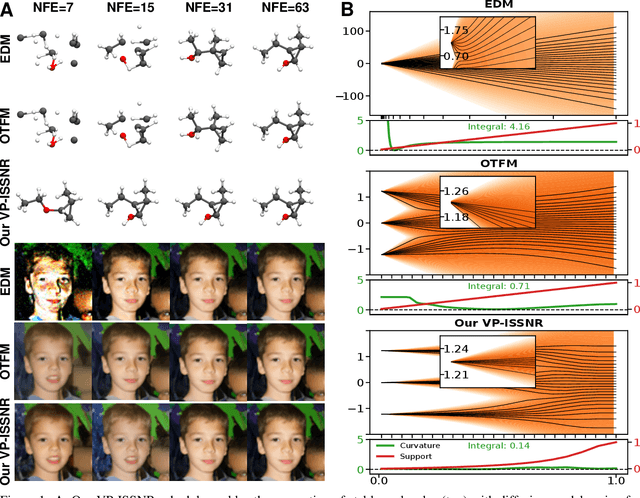
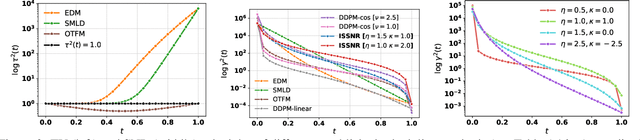
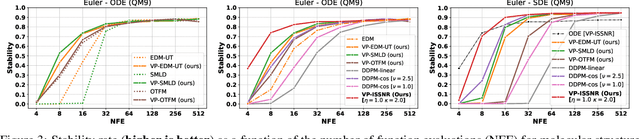
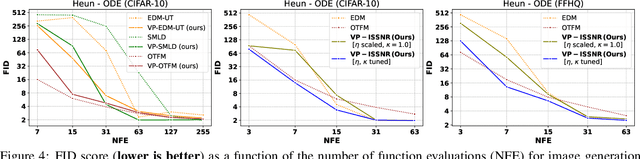
The long sampling time of diffusion models remains a significant bottleneck, which can be mitigated by reducing the number of diffusion time steps. However, the quality of samples with fewer steps is highly dependent on the noise schedule, i.e., the specific manner in which noise is introduced and the signal is reduced at each step. Although prior work has improved upon the original variance-preserving and variance-exploding schedules, these approaches $\textit{passively}$ adjust the total variance, without direct control over it. In this work, we propose a novel total-variance/signal-to-noise-ratio disentangled (TV/SNR) framework, where TV and SNR can be controlled independently. Our approach reveals that different existing schedules, where the TV explodes exponentially, can be $\textit{improved}$ by setting a constant TV schedule while preserving the same SNR schedule. Furthermore, generalizing the SNR schedule of the optimal transport flow matching significantly improves the performance in molecular structure generation, achieving few step generation of stable molecules. A similar tendency is observed in image generation, where our approach with a uniform diffusion time grid performs comparably to the highly tailored EDM sampler.
Bayesian Parameter Shift Rule in Variational Quantum Eigensolvers
Feb 04, 2025Parameter shift rules (PSRs) are key techniques for efficient gradient estimation in variational quantum eigensolvers (VQEs). In this paper, we propose its Bayesian variant, where Gaussian processes with appropriate kernels are used to estimate the gradient of the VQE objective. Our Bayesian PSR offers flexible gradient estimation from observations at arbitrary locations with uncertainty information and reduces to the generalized PSR in special cases. In stochastic gradient descent (SGD), the flexibility of Bayesian PSR allows the reuse of observations in previous steps, which accelerates the optimization process. Furthermore, the accessibility to the posterior uncertainty, along with our proposed notion of gradient confident region (GradCoRe), enables us to minimize the observation costs in each SGD step. Our numerical experiments show that the VQE optimization with Bayesian PSR and GradCoRe significantly accelerates SGD and outperforms the state-of-the-art methods, including sequential minimal optimization.
Adaptive Observation Cost Control for Variational Quantum Eigensolvers
Feb 03, 2025The objective to be minimized in the variational quantum eigensolver (VQE) has a restricted form, which allows a specialized sequential minimal optimization (SMO) that requires only a few observations in each iteration. However, the SMO iteration is still costly due to the observation noise -- one observation at a point typically requires averaging over hundreds to thousands of repeated quantum measurement shots for achieving a reasonable noise level. In this paper, we propose an adaptive cost control method, named subspace in confident region (SubsCoRe), for SMO. SubsCoRe uses the Gaussian process (GP) surrogate, and requires it to have low uncertainty over the subspace being updated, so that optimization in each iteration is performed with guaranteed accuracy. The adaptive cost control is performed by first setting the required accuracy according to the progress of the optimization, and then choosing the minimum number of measurement shots and their distribution such that the required accuracy is satisfied. We demonstrate that SubsCoRe significantly improves the efficiency of SMO, and outperforms the state-of-the-art methods.
Enhancing Brain Source Reconstruction through Physics-Informed 3D Neural Networks
Oct 31, 2024Reconstructing brain sources is a fundamental challenge in neuroscience, crucial for understanding brain function and dysfunction. Electroencephalography (EEG) signals have a high temporal resolution. However, identifying the correct spatial location of brain sources from these signals remains difficult due to the ill-posed structure of the problem. Traditional methods predominantly rely on manually crafted priors, missing the flexibility of data-driven learning, while recent deep learning approaches focus on end-to-end learning, typically using the physical information of the forward model only for generating training data. We propose the novel hybrid method 3D-PIUNet for EEG source localization that effectively integrates the strengths of traditional and deep learning techniques. 3D-PIUNet starts from an initial physics-informed estimate by using the pseudo inverse to map from measurements to source space. Secondly, by viewing the brain as a 3D volume, we use a 3D convolutional U-Net to capture spatial dependencies and refine the solution according to the learned data prior. Training the model relies on simulated pseudo-realistic brain source data, covering different source distributions. Trained on this data, our model significantly improves spatial accuracy, demonstrating superior performance over both traditional and end-to-end data-driven methods. Additionally, we validate our findings with real EEG data from a visual task, where 3D-PIUNet successfully identifies the visual cortex and reconstructs the expected temporal behavior, thereby showcasing its practical applicability.
Flow-based Sampling for Entanglement Entropy and the Machine Learning of Defects
Oct 18, 2024


We introduce a novel technique to numerically calculate R\'enyi entanglement entropies in lattice quantum field theory using generative models. We describe how flow-based approaches can be combined with the replica trick using a custom neural-network architecture around a lattice defect connecting two replicas. Numerical tests for the $\phi^4$ scalar field theory in two and three dimensions demonstrate that our technique outperforms state-of-the-art Monte Carlo calculations, and exhibit a promising scaling with the defect size.
Towards Symbolic XAI -- Explanation Through Human Understandable Logical Relationships Between Features
Aug 30, 2024Explainable Artificial Intelligence (XAI) plays a crucial role in fostering transparency and trust in AI systems, where traditional XAI approaches typically offer one level of abstraction for explanations, often in the form of heatmaps highlighting single or multiple input features. However, we ask whether abstract reasoning or problem-solving strategies of a model may also be relevant, as these align more closely with how humans approach solutions to problems. We propose a framework, called Symbolic XAI, that attributes relevance to symbolic queries expressing logical relationships between input features, thereby capturing the abstract reasoning behind a model's predictions. The methodology is built upon a simple yet general multi-order decomposition of model predictions. This decomposition can be specified using higher-order propagation-based relevance methods, such as GNN-LRP, or perturbation-based explanation methods commonly used in XAI. The effectiveness of our framework is demonstrated in the domains of natural language processing (NLP), vision, and quantum chemistry (QC), where abstract symbolic domain knowledge is abundant and of significant interest to users. The Symbolic XAI framework provides an understanding of the model's decision-making process that is both flexible for customization by the user and human-readable through logical formulas.
Physics-Informed Bayesian Optimization of Variational Quantum Circuits
Jun 10, 2024



In this paper, we propose a novel and powerful method to harness Bayesian optimization for Variational Quantum Eigensolvers (VQEs) -- a hybrid quantum-classical protocol used to approximate the ground state of a quantum Hamiltonian. Specifically, we derive a VQE-kernel which incorporates important prior information about quantum circuits: the kernel feature map of the VQE-kernel exactly matches the known functional form of the VQE's objective function and thereby significantly reduces the posterior uncertainty. Moreover, we propose a novel acquisition function for Bayesian optimization called Expected Maximum Improvement over Confident Regions (EMICoRe) which can actively exploit the inductive bias of the VQE-kernel by treating regions with low predictive uncertainty as indirectly ``observed''. As a result, observations at as few as three points in the search domain are sufficient to determine the complete objective function along an entire one-dimensional subspace of the optimization landscape. Our numerical experiments demonstrate that our approach improves over state-of-the-art baselines.